


How often can you recognize how someone truly feels at work?
Unlike toddlers, our colleagues don’t stop and announce, “I’m mad!” Instead, they tend to suppress their emotions, making it difficult to know how they feel.
Imagine, though, how your workday might unfold if you had more clarity. Before giving a colleague bad news, you might learn that they’re on the edge of an emotional meltdown, causing you to reframe your message and show more compassion. By doing so, you gain their trust and respect, and they hear your message better, too.
Or, you might learn that an employee on your team feels especially bold and confident right now, marking the perfect opportunity to add extra responsibilities to their workload without causing them to feel overwhelmed.
Adapting behavior in this way requires awareness of the emotional situation, sometimes called emotional intelligence. As these scenarios suggest, the ability to recognize and respond to emotions unlocks great power in the workplace.
Defining Emotions
Emotions are short-lived, intense responses to the world around us. They are the warm joy when our work is applauded by a teammate, the flash of hot anger in response to being cut off in a meeting, or the flush of shame when we make a critical mistake.
They differ from moods, which last longer than emotions. When we go through an entire workday with a general sense of happiness, that happy disposition is a mood, not our emotion. Instead, emotions change from one moment to the next based on what we experience. Imagine a day when you’re in a good mood, for example, and then you trip and fall. That trip triggers intense emotions, such as embarrassment or worry, which come on quickly and then pass as soon as you realize that nobody saw you. That quick onset of embarrassment reflects the immediacy of emotions.
As you can imagine by now, emotions help us navigate daily experiences that can make or break our career potential. Yet, we too often ignore these experiences rather than pause to reflect on them. (Why do we feel embarrassed after a fall, anyway?)
Perhaps we ignore emotions because they are complex, nuanced psychological phenomena that we do not fully understand. Reflecting on them requires knowledge and practice. The good news is: We have a guide to help you.
A Guide to Understanding Emotions
Psychologists organize emotions into two dimensions: positivity (also called valence) and activation (sometimes referred to as arousal). Together they make up the circumplex model of emotions.
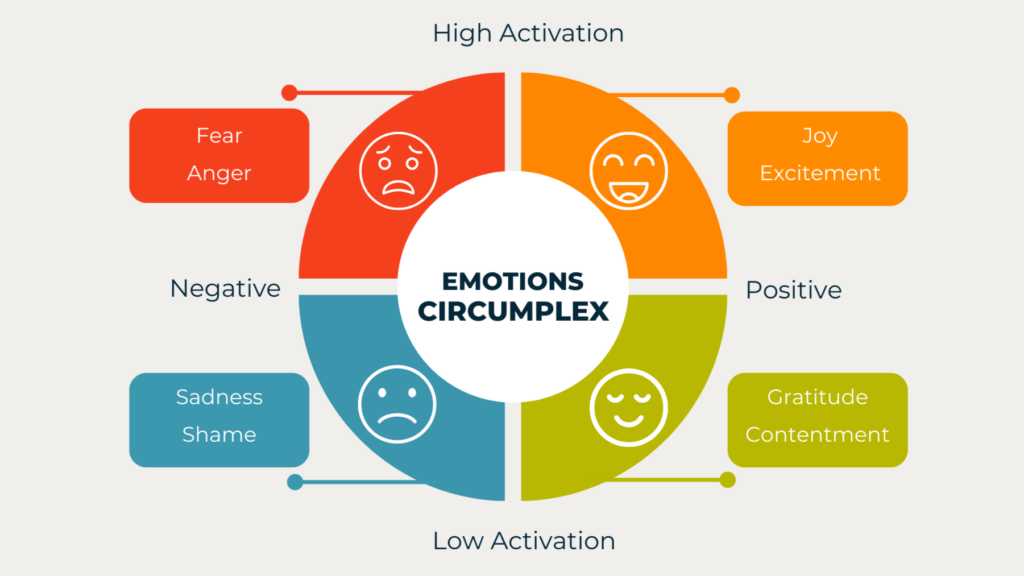
The positivity dimension refers to pleasant versus unpleasant emotions. In most cases, we seek out situations that result in more pleasant feelings, and we avoid situations that result in negative feelings.
Certain emotions, whether positive or negative, may also coincide with different levels of physical and psychological activation, which is the second dimension. Activation refers to changes in our body’s internal activity, like heart rate, blood flow (i.e., blushing), and sweating. While sadness and fear are both negative emotional experiences, sadness slows us down due to low activation and fear prompts us to act quickly due to high activation.
Positive vs Negative Emotions and Engagement at Work
Positive emotions with high activation, such as happiness and excitement, promote creativity and productivity at work.
While happiness energizes us, contentment might not, even though both are positive emotions. That’s the difference between high and low activation. Contentment does not trigger action.
Yet, contentment is still pleasant, so we seek to maintain the experience even if it may not energize us. Contentment at work keeps us from looking for another job.
Surprisingly, negative emotions with high activation can reflect high engagement with our work. We get angry or worry when we care. If we were less engaged, we would feel less distressed when we fail to achieve a goal, for example.
Finally, negative emotions with low activation, like boredom, are the ultimate form of disengagement. Our careers and colleagues suffer when we are in this emotional state.
The Power of Emotions
Emotions are powerful forces that shape our behavior and performance at work. Whether we want to foster creativity, productivity, engagement, or trust, emotions can help. The next time you recognize an emotion in the workplace, don’t ignore it. Instead, use it as a guide to improve your career or your team.
tags: impact & outcomes / leadership skills / science
