


Think about someone you knew years ago who was quiet in groups but now speaks up with confidence. Or someone who once struggled to stay organized but now reliably follows through.
Did they change their personality?
For decades, researchers have emphasized that personality is stable and enduring. Personality refers to the usual ways people think, feel, and behave. Traits such as conscientiousness, extraversion, and emotional stability tend to remain fairly consistent over time.
That stability is one reason why some employers use personality assessments when making hiring decisions. Insights about a candidate’s personality traits, especially conscientiousness, can help employers predict who will perform better on the job if hired. They offer useful information about the tendencies people may bring to a role.
In a study of 6,800 adults, about 90% reported wanting to increase at least one of the Big Five personality traits: extraversion, agreeableness, conscientiousness, emotional stability, or openness. Many people want to become more confident, patient, dependable, calm under pressure, or open to new ideas.
So, can they?
What the Science Says About Personality Change
Recent research suggests that personality can change, especially when people are motivated to change and make a consistent effort.
In a series of studies, researchers asked people to choose a personality trait they wanted to develop. Participants then practiced small behaviors connected to that goal. Someone who wanted to become more extraverted might start a conversation with a new person. Someone who wanted to become more conscientious might create a weekly plan or organize their workspace.
Participants also reflected on their progress, effort, and challenges along the way.
The results showed that people can make intentional changes in personality traits. The people who made the most progress did more than set a goal. They consistently practiced the behaviors tied to it. In later research, following through on behavioral goals predicted greater personality change.
Digital programs can support this process, too. In a large randomized controlled trial, more than 1,500 participants used a smartphone-based program that combined personalized goals, small behavioral exercises, and reflection prompts. Participants showed greater movement toward their desired changes than those who did not receive the intervention. Follow-up research examined the extent to which those changes lasted over time.
The takeaway is simple: personality change takes time, effort, and motivation. People are more likely to change when they have a meaningful goal and a chance to practice new ways of responding.
What Does Personality Change Have to Do With Leadership?
Personality matters for leadership because it is closely connected to many of the skills people use at work. For example, conscientiousness is related to planning and following through; extraversion is related to speaking up and influencing others; and emotional stability is related to managing stress and responding constructively under pressure.
Leadership Development
Personality is connected to the skills leaders use at work.
Research links the Big Five personality traits to five broad areas of workplace capability.
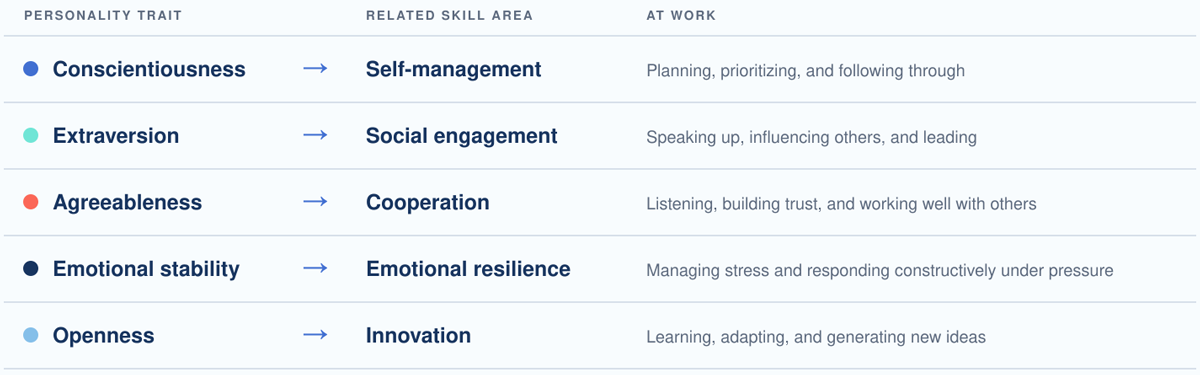
Figure. Connections between Big Five personality traits and workplace skills, based on Soto et al.’s (2022) framework.
This is where personality-change research matters for leadership. If repeated, goal-directed behavior can gradually shift the ways people tend to think, feel, and act, then it may also help leaders strengthen the skills that matter most at work.
Understanding how personality relates to workplace skills can help identify where a leader may benefit from focused development. Effective development can then give leaders clear opportunities to build and practice the behaviors that support stronger self-management, collaboration, resilience, influence, and adaptability.
What These Findings Mean for Leadership Development
This research has several useful implications for leadership development.
First, to improve leader behavior, leadership development should focus on the specific behaviors that need to change. Telling a manager to “be more confident” is unlikely to help because it is too vague. Giving them a small, concrete behavior to practice before their next team meeting would be far more useful.
Second, any development focused on lasting behavior change should include repeated practice. People are more likely to change when they can try a behavior, reflect on what happened, and try again. One workshop can create awareness. Lasting growth usually requires more opportunities to practice in real work situations.
Finally, leadership assessments can be used as a starting point for leadership development, not simply a screening tool for hiring and promotion. Assessments can help people understand their tendencies, identify situations that may be more challenging, and set practical behavioral goals that support their growth.
Most people want to change at least one aspect of their personality—and research suggests they can make meaningful progress. For leadership development and HR professionals, the opportunity is to support that growth by helping people identify meaningful goals, practice relevant behaviors, and build skills over time.
tags: leadership / leadership development / leadership skills / science / trends
